Ventricular fibrillation causes uncoordinated quivering of the ventricle with no useful contractions. It causes immediate syncope and death within minutes. Treatment is with cardiopulmonary resuscitation, including immediate defibrillation.
Ventricular fibrillation (VF) is due to multiple wavelet reentrant electrical activity and is manifested on electrocardiogram (ECG) by ultrarapid baseline undulations that are irregular in timing and morphology. (See also Overview of Arrhythmias.)
VF has been reported to be the presenting rhythm in approximately 25 to 60% of cardiac arrests (1, 2, 3). Nevertheless, because VF leads to asystole with time, this proportion is an underestimate. Accordingly, VF is still the terminal event in many disorders. Overall, most patients with VF have an underlying heart disorder (typically ischemic cardiomyopathy, but also hypertrophic cardiomyopathy or dilated cardiomyopathy, or other arrhythmogenic cardiovascular disorders). Patients in whom no underlying disorder is detected are considered to have idiopathic VF. Risk of VF in any disorder is increased by electrolyte abnormalities, acidosis, hypoxemia, or ischemia.
Ventricular fibrillation is much less common among infants and children, in whom other, "nonshockable," rhythms such as asystole and pulseless electrical activity are more common presentations of cardiac arrest (4).

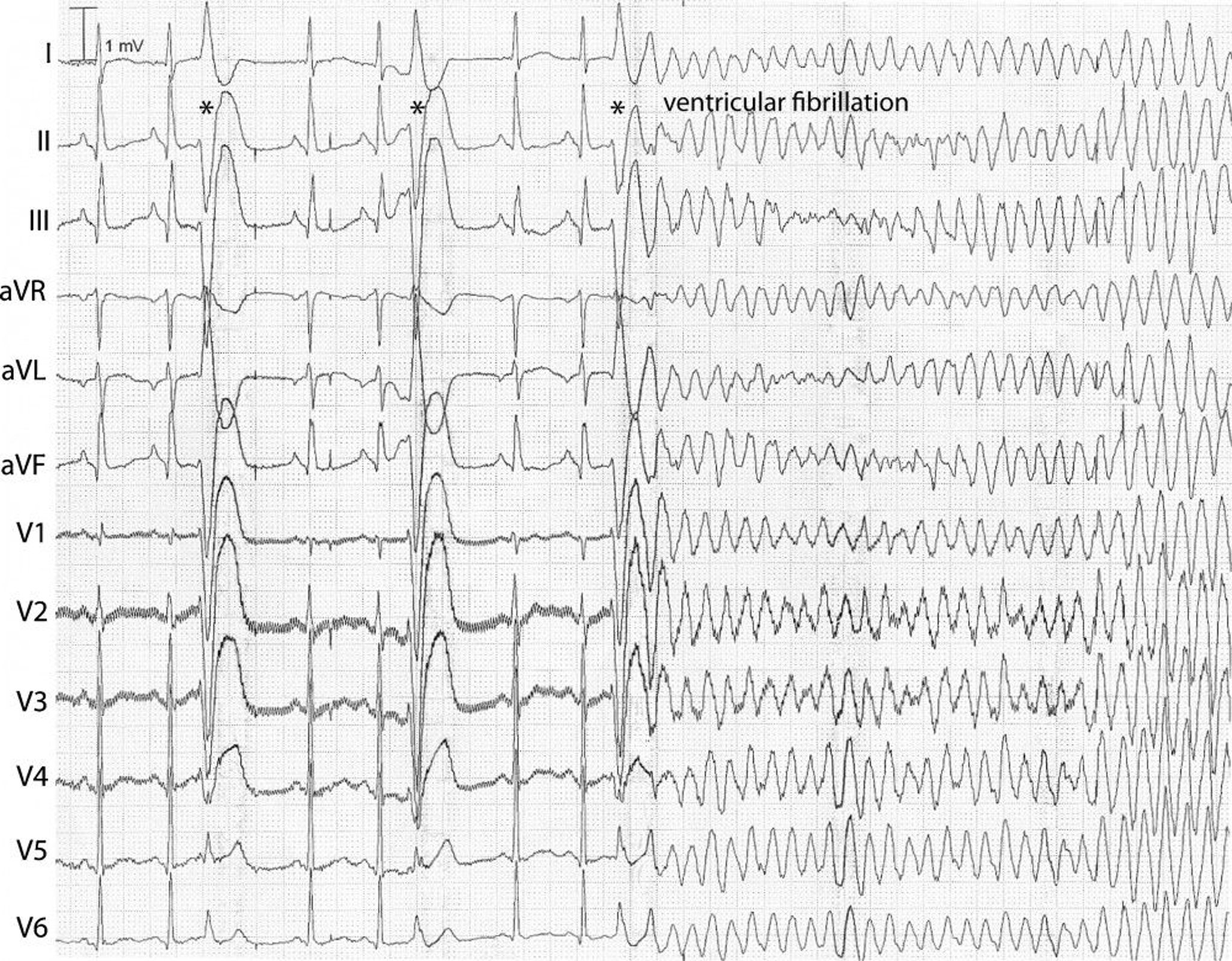
These rhythm strips show the ultrarapid baseline undulations, irregular in timing and morphology, that characterize ventricular fibrillation. The asterisks indicate close-coupled premature ventricular beats.
© Springer Science+Business Media

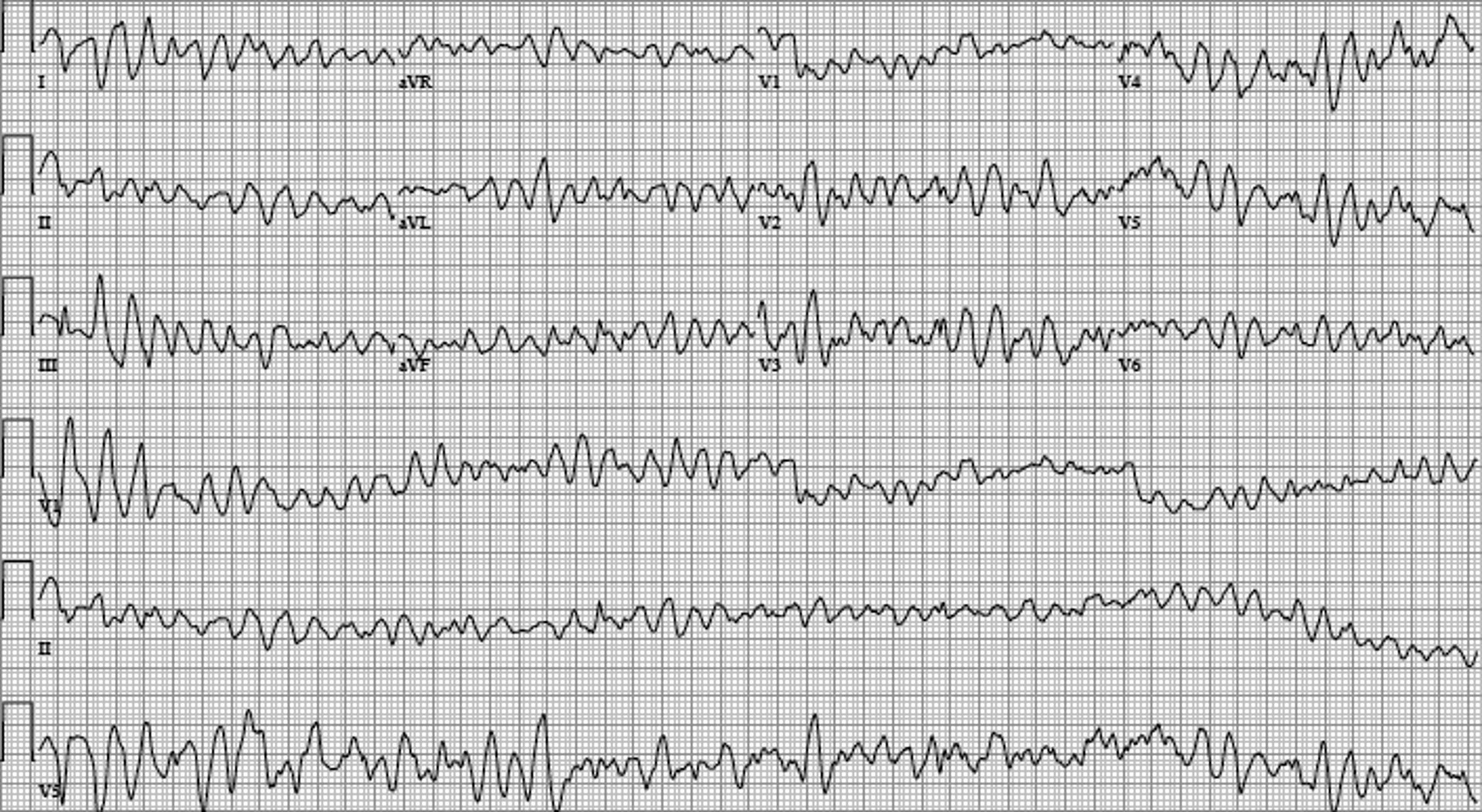
Image courtesy of L. Brent Mitchell, MD.
Idiopathic ventricular fibrillation
Patients who have been resuscitated from VF cardiac arrest are evaluated for cardiac disease, particularly coronary artery disease, cardiomyopathies, and channelopathies (5). If comprehensive electrocardiographic, imaging, and provocative testing do not identify any such causative disorder, the patient is considered to have idiopathic ventricular fibrillation. It is thought that some of these patients likely have an unrecognized or unknown genetic disorder. Because of the possibility that the disorder is familial, it is recommended that family members undergo close surveillance for possible cardiac events (eg, syncope, palpitations) and, should any occur, undergo testing, including ECG, exercise stress testing, and echocardiography. Genetic testing of survivors and cascade genetic testing of family members is performed in selected patients with nonischemic cardiomyopathy or a suspected channelopathy (5) (see also Arrhythmogenic Cardiac Disorders). Treatment is an implantable cardioverter-defibrillator (5).
General references
1. Bayés de Luna A, Coumel P, Leclercq JF. Ambulatory sudden cardiac death: mechanisms of production of fatal arrhythmia on the basis of data from 157 cases. Am Heart J. 1989;117(1):151-159. doi:10.1016/0002-8703(89)90670-4
2. Cobb LA, Fahrenbruch CE, Olsufka M, et al. Changing incidence of out-of-hospital ventricular fibrillation, 1980-2000. JAMA. 2002;288(23):3008-3013. doi:10.1001/jama.288.23.3008
3. Weisfeldt ML, Everson-Stewart S, Sitlani C, et al. Ventricular tachyarrhythmias after cardiac arrest in public versus at home. N Engl J Med. 2011;364(4):313-321. doi:10.1056/NEJMoa1010663
4. Joyner BL Jr, Dewan M, Bavare A, et al. Part 6: Pediatric Basic Life Support: 2025 American Heart Association and American Academy of Pediatrics Guidelines for Cardiopulmonary Resuscitation and Emergency Cardiovascular Care. Pediatrics. 2026;157(1):e2025074350. doi:10.1542/peds.2025-074350
5. Al-Khatib SM, Stevenson WG, Ackerman MJ, et al. 2017 AHA/ACC/HRS guideline for management of patients with ventricular arrhythmias and the prevention of sudden cardiac death: a report of the American College of Cardiology Foundation/American Heart Association Task Force on Clinical Practice Guidelines and the Heart Rhythm Society. J Am Coll Cardiol. 2018;72(14):e91-e220. doi:10.1016/j.jacc.2017.10.054
Treatment of Ventricular Fibrillation
Defibrillation and cardiopulmonary resuscitation
Implantable cardioverter-defibrillator
Treatment of ventricular fibrillation is with cardiopulmonary resuscitation, including defibrillation, beginning with biphasic 120 to 200 joules (or monophasic 360 joules) (1). The success rate for immediate defibrillation (within 5 seconds as can be achieved by an implantable cardioverter-defibrillator) in multiple studies is approximately 95 to 100% provided that overwhelming pump failure does not preexist (2). Thereafter, the first shock defibrillation success rate decreases by approximately 10% per minute (3); similarly, the likelihood of neurologically intact survival decreases by approximately 7% per minute of delay until first shock even when the VF ultimately requires multiple shocks (4). A recent randomized trial has demonstrated that patients with VF resistant to defibrillation with multiple shocks appear to benefit from changing the shock vector (from the usual anterolateral pad placement to anteroposterior pad placement) or from double sequential external defibrillation (using 2 defibrillators and delivering an anterolateral shock followed immediately by an anteroposterior shock) (5).
Patients who have VF without a reversible or transient cause are at high risk of future VF events and of sudden death (6). Most of these patients require an implantable cardioverter-defibrillator; many require concomitant antiarrhythmic medications to reduce the frequency of subsequent episodes of ventricular tachycardia and VF (7).

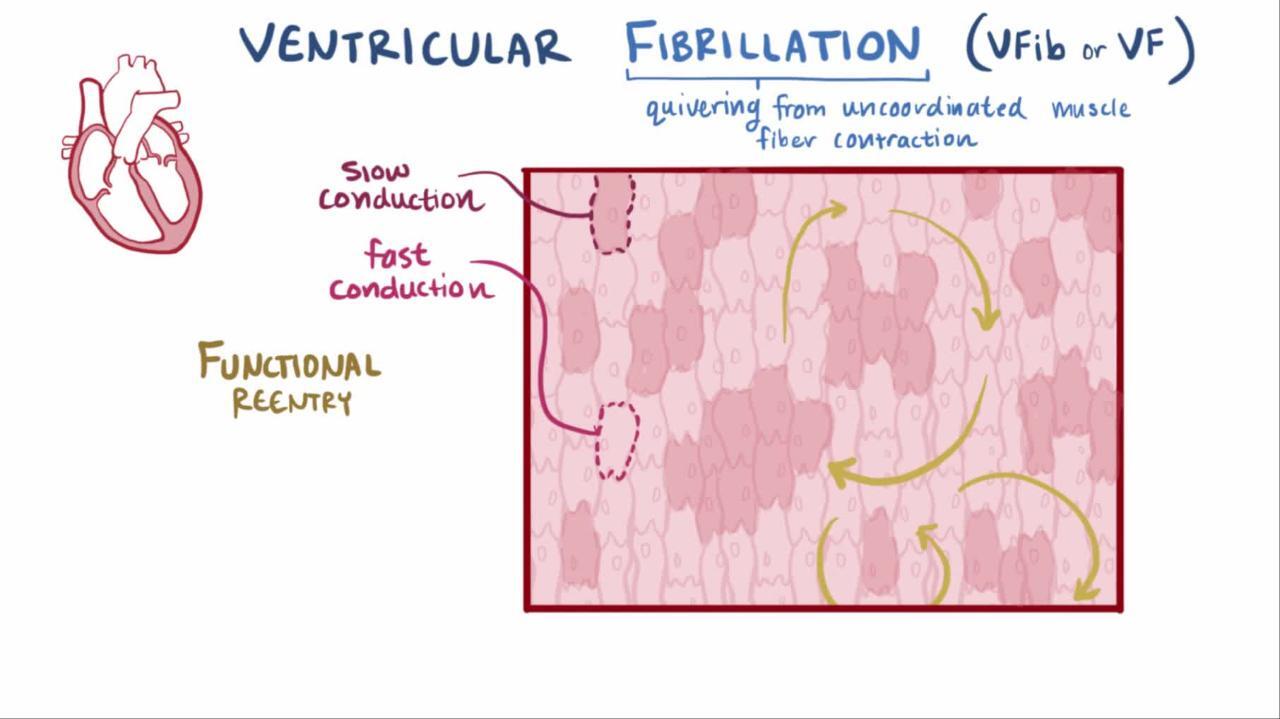
Ventricular Fibrillation (VF or V-Fib) (https://www.youtube.com/watch?v=kETghJagzOY) by Osmosis (https://open.osmosis.org/) is licensed under CC-BY-SA 4.0 (https://creativecommons.org/licenses/by-sa/4.0/).
Treatment references
1. Wigginton JG, Agarwal S, Bartos JA, et al. Part 9: Adult Advanced Life Support: 2025 American Heart Association Guidelines for Cardiopulmonary Resuscitation and Emergency Cardiovascular Care. Circulation. 2025;152(16_suppl_2):S538-S577. doi:10.1161/CIR.0000000000001376
2. Lewis GF, Gold MR. Safety and Efficacy of the Subcutaneous Implantable Defibrillator. J Am Coll Cardiol. 2016;67(4):445-454. doi:10.1016/j.jacc.2015.11.026
3. van Alem AP, Chapman FW, Lank P, et al. A prospective, randomised and blinded comparison of first shock success of monophasic and biphasic waveforms in out-of-hospital cardiac arrest. Resuscitation. 2023;58(1):17-24. doi:10.1016/s0300-9572(03)00106-0
4. Lee SGW, Park JH, Ro YS, Hong KJ, Song KJ, Shin SD. Time to first defibrillation and survival outcomes of out-of-hospital cardiac arrest with refractory ventricular fibrillation. Am J Emerg Med. 2021;40:96-102. doi:10.1016/j.ajem.2020.12.019
5. Cheskes S, Verbeek PR, Drennan IR, et al. Defibrillation Strategies for Refractory Ventricular Fibrillation. N Engl J Med. 2022;387(21):1947-1956. doi:10.1056/NEJMoa2207304
6. Nehme Z, Andrew E, Nair R, Bernard S, Smith K. Recurrent out-of-hospital cardiac arrest. Resuscitation. 2017;121:158-165. doi:10.1016/j.resuscitation.2017.08.011
7. Al-Khatib SM, Stevenson WG, Ackerman MJ, et al. 2017 AHA/ACC/HRS guideline for management of patients with ventricular arrhythmias and the prevention of sudden cardiac death: a report of the American College of Cardiology Foundation/American Heart Association Task Force on Clinical Practice Guidelines and the Heart Rhythm Society. J Am Coll Cardiol. 2018;72(14):e91-e220. doi:10.1016/j.jacc.2017.10.054